Last Updated on July 19, 2026 by Dr. Sushanta Barman
Researchers at Stanford University have demonstrated that a 97.9 MHz surface acoustic wave can mechanically modulate the Mössbauer nuclear resonance of \(^{57}\)Fe in a chip-scale quartz device. The acoustic wave periodically moves the iron absorber, producing a time-dependent Doppler shift and a comb of absorption sidebands in the Mössbauer spectrum. The result establishes a high-bandwidth interface between nuclear resonances and solid-state acoustics, with potential applications in gamma-ray quantum optics, precision nuclear spectroscopy, and future nuclear-clock control.
The work was reported by Albert Nazeeri, Chiara Brandenstein, Chengjie Jia, Lorenzo Magrini, and Giorgio Gratta in the paper “Coupling of a Nuclear Transition to a Surface Acoustic Wave,” published in Physical Review Letters on May 5, 2026, DOI: 10.1103/tc97-98f7.
The experiment relies on the Mössbauer effect, in which certain atomic nuclei emit and absorb gamma rays without losing energy through recoil. Because these nuclear transitions are extremely narrow and stable, they are widely used in precision spectroscopy and tests of fundamental physics.
In the new study, the researchers showed that these nuclear transitions can be periodically modulated using surface acoustic waves (SAWs), microscopic vibrations that move along the surface of a solid.
Surface Acoustic Waves Modulate Nuclear Transitions
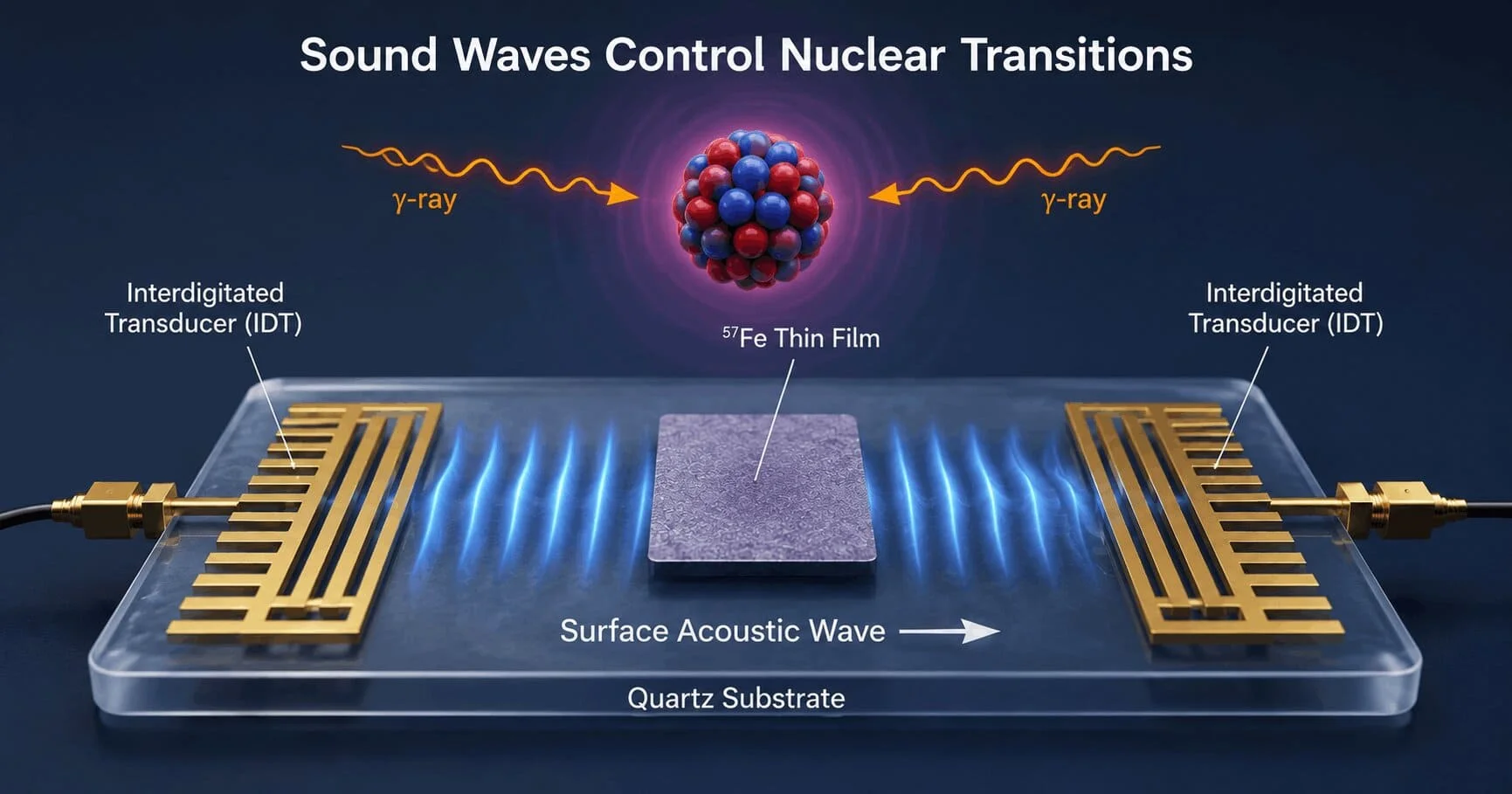
The team deposited a thin film enriched with the isotope iron-57 onto a quartz chip designed to generate surface acoustic waves. These waves behave like tiny ripples moving across the crystal surface. When the device was driven at 97.9 MHz, the moving surface periodically shifted the nuclear transition energy through the Doppler effect. As a result, additional absorption peaks appeared in the Mössbauer spectrum. These peaks, called sidebands, are a characteristic signature of periodic driving.
The researchers describe this as “…the highest-frequency phonon-driven modulation of Mössbauer resonances reported to date.”
The modulation frequency is much larger than the natural linewidth of the nuclear transition. This means the nuclei are driven faster than their intrinsic decay dynamics, allowing coherent manipulation of the nuclear response.
Chip-Based Acoustic Device
Earlier experiments on mechanically driven Mössbauer systems relied on comparatively large piezoelectric transducers. In contrast, the Stanford device is built entirely on a chip. The system uses interdigitated transducers, microscopic comb-shaped metal electrodes patterned on quartz. Applying a radio-frequency signal launches acoustic waves with a wavelength of about 32 micrometers along the chip surface.
A thin iron-57 layer was positioned between two transducers inside a standard Mössbauer spectrometer. Because the acoustic energy remains concentrated near the surface, the modulation becomes more efficient. The chip-scale design also reduces mechanical losses that typically occur in larger vibration-based systems.
Observation of Nuclear Sidebands
As the acoustic power increased, the researchers observed multiple new absorption peaks forming symmetrically around the original Mössbauer resonance. The sidebands followed the behavior predicted by Floquet theory and by Bessel-function scaling, both well-known signatures of driven quantum systems. The spectra showed as many as 18 distinct absorption peaks associated with different vibrational sidebands. To study the effect quantitatively, the researchers fitted the spectra using Lorentzian line profiles and reconstructed the vibration amplitudes from the sideband intensities. The measured results closely matched theoretical predictions. The analysis also showed that the surface vibrations were transferred efficiently into the iron film, allowing the nuclear transitions to respond directly to the acoustic motion.
Possible Applications
The work introduces a new method for dynamically controlling nuclear transitions using solid-state acoustic devices. One possible application is in gamma-ray quantum optics, where researchers aim to manipulate nuclear transitions in ways similar to how lasers control electronic transitions in atoms.
The authors suggest that specially designed acoustic waveforms could eventually provide programmable control of nuclear states. When combined with synchrotron x-ray sources, such systems may support advanced time-domain techniques, including interferometric and phase-control methods.
The study also points toward applications in nuclear clocks. Unlike ordinary atomic clocks, nuclear clocks use transitions inside the nucleus and may achieve even higher stability and precision. The paper specifically discusses the thorium-229 nuclear transition, which is considered one of the leading candidates for future nuclear-clock technology. According to the authors, coupling surface acoustic waves to nuclear systems “may offer a promising route for the dynamic control of nuclear clocks.”
Acoustics and Nuclear Control
Surface acoustic waves are already widely used in electronics and quantum-device engineering, including microwave filters, quantum transducers, and superconducting quantum systems. By directly coupling these waves to nuclear transitions, the Stanford team has created a new experimental platform linking acoustics, condensed-matter physics, and nuclear spectroscopy.
The work also reflects a broader trend in modern physics: techniques developed for quantum control are increasingly being applied to nuclear systems, which have traditionally been much harder to manipulate dynamically. The researchers conclude that the study “establishes a new interface between nuclear transitions and high-frequency acoustics.”
Read the full article: A. Nazeeri et al., “Coupling of a Nuclear Transition to a Surface Acoustic Wave,” Phys. Rev. Lett. 136, 183801 (2026), DOI: 10.1103/tc97-98f7.

Dr. Sushanta Barman is a Postdoctoral Fellow at the Tata Institute of Fundamental Research, working on quantum physics and matter-wave phenomena. Through MatterWaveX, he shares articles on modern physics, quantum technology, and scientific simulations.


